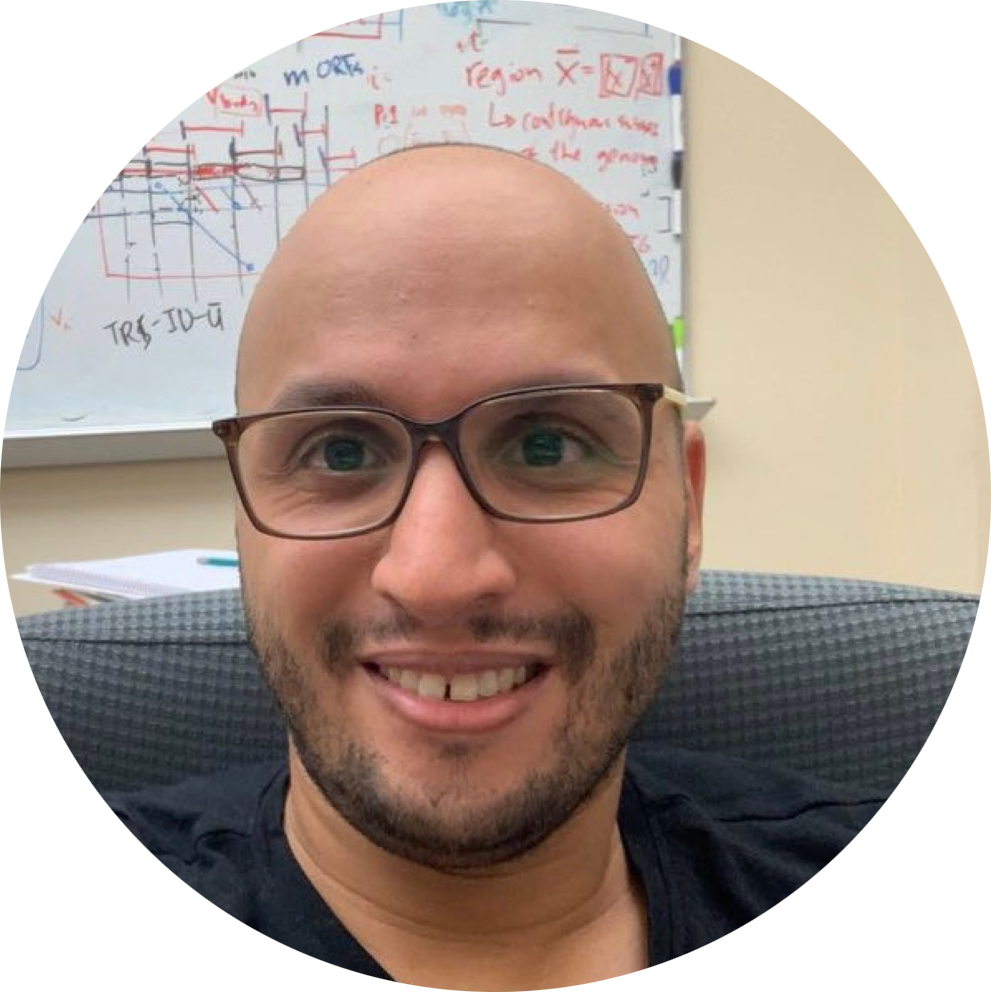
Mohammed El-Kebir
melkebir[AT]illinois[DOT]edu
Jump to: description | schedule | homework | project | statements
| Semester | Spring 2026 |
| Instructor | Prof. Mohammed El-Kebir |
| TAs | Mrinmoy Roddur (mroddur2) |
| Time | TR 9:30-10:45 AM |
| Location | 1404 Siebel Center |
| Instructor office hours | Thursdays 11:00-noon in 3216 Siebel Center |
| TA office hours | Mrinmoy (mroddur2): Tuesdays, 3-4 PM in CS Tutoring Center (Siebel basement) |
| Piazza | [link] |
This course introduces fundamental problems and algorithmic approaches in computational biology. Covered topics include:
Undergraduates will receive 3 undergraduate credits; graduate students can enroll for 3 or 4 graduate credits.
3-credit students:This is a tentative schedule and subject to change. Recordings are available on mediaspace. To access slides and other materials, log in to Google drive using your Illinois email address; *not* your personal gmail. If your Google account has not been activated yet, please follow the instructions here.
| Date | Presenter | Slides | Reading |
| 01/20/2026 | Mohammed El-Kebir | Introduction [slides] [jupyter] |
|
| 01/22/2026 | Mohammed El-Kebir | Sequence alignment I [slides] [annotated slides] |
|
| 01/27/2026 | Mohammed El-Kebir | Sequence alignment II [slides] [annotated slides] |
|
| 01/29/2026 | Mohammed El-Kebir | Sequence alignment III [slides] [annotated slides] |
|
| 02/03/2026 | Mohammed El-Kebir | Sequence alignment IV [slides] [annotated slides] |
|
| 02/05/2026 | Mohammed El-Kebir | Multiple Sequence Alignment I [slides] [annotated slides] |
|
| 02/10/2026 | Mohammed El-Kebir | Multiple Sequence Alignment II [slides] [annotated slides] |
|
| 02/12/2026 | Mohammed El-Kebir | Multiple Sequence Alignment III [slides] [annotated slides] |
|
| 02/17/2026 | Mohammed El-Kebir | Multiple Sequence Alignment IV [slides] [annotated slides] |
|
| 02/19/2026 | Mohammed El-Kebir | Research Presentation [paper] [slides] [annotated slides] | |
| 02/24/2026 | Mohammed El-Kebir | RNA Secondary Structure Prediction I [slides] | |
| 02/26/2026 | Mohammed El-Kebir | RNA Secondary Structure -- Research [slides I] [slides II] | |
| 03/03/2026 | Mohammed El-Kebir | Midterm Review | |
| 03/04/2026 | Mohammed El-Kebir | Midterm Exam (7-9:50pm) | |
| 03/05/2026 | Mohammed El-Kebir | Canceled | |
| 03/10/2026 | Mohammed El-Kebir | Phylogeny I [slides] [annotated slides] |
|
| 03/12/2026 | Mohammed El-Kebir | Phylogeny II [slides] [annotated slides] |
|
| 03/24/2026 | Mohammed El-Kebir | Midterm Discussion [slides] | |
| 03/26/2026 | Mohammed El-Kebir | Phylogeny III [slides] [annotated slides] |
|
| 03/31/2026 | Mohammed El-Kebir | Phylogeny IV [slides] |
|
| 04/02/2026 | Mohammed El-Kebir | Phylogeny V [slides] |
|
| 04/07/2026 | Mohammed El-Kebir | HMM I [slides] [annotated slides] |
|
| 04/09/2026 | Mohammed El-Kebir | HMM II [slides] [annotated slides] |
|
| 04/14/2026 | Mohammed El-Kebir | HMM III [slides I] [slides II] [annotated slides] |
|
| 04/16/2026 | Mohammed El-Kebir | Research Presentation [slides] | |
| 04/21/2026 | Mohammed El-Kebir | Genome Assembly I [slides 0] [slides I] [slides II] [slides III] |
|
| 04/23/2026 | Mohammed El-Kebir | Genome Assembly II [slides I] [slides II] [slides III] | |
| 04/28/2026 | Mohammed El-Kebir | Project Presentations I |
|
| 04/30/2026 | Mohammed El-Kebir | Project Presentations II | |
| 05/05/2026 | Mohammed El-Kebir | Final Exam Review |
The Grainger College of Engineering is committed to the creation of an anti-racist, inclusive community that welcomes diversity along a number of dimensions, including, but not limited to, race, ethnicity and national origins, gender and gender identity, sexuality, disability status, class, age, or religious beliefs. The College recognizes that we are learning together in the midst of the Black Lives Matter movement, that Black, Hispanic, and Indigenous voices and contributions have largely either been excluded from, or not recognized in, science and engineering, and that both overt racism and micro-aggressions threaten the well-being of our students and our university community.
The effectiveness of this course is dependent upon each of us to create a safe and encouraging learning environment that allows for the open exchange of ideas while also ensuring equitable opportunities and respect for all of us. Everyone is expected to help establish and maintain an environment where students, staff, and faculty can contribute without fear of personal ridicule, or intolerant or offensive language. If you witness or experience racism, discrimination, micro-aggressions, or other offensive behavior, you are encouraged to bring this to the attention of the course director if you feel comfortable. You can also report these behaviors to the Bias Assessment and Response Team (BART) (https://bart.illinois.edu/). Based on your report, BART members will follow up and reach out to students to make sure they have the support they need to be healthy and safe. If the reported behavior also violates university policy, staff in the Office for Student Conflict Resolution may respond as well and will take appropriate action.
Diminished mental health, including significant stress, mood changes, excessive worry, substance/alcohol abuse, or problems with eating and/or sleeping can interfere with optimal academic performance, social development, and emotional wellbeing. The University of Illinois offers a variety of confidential services including individual and group counseling, crisis intervention, psychiatric services, and specialized screenings at no additional cost. If you or someone you know experiences any of the above mental health concerns, it is strongly encouraged to contact or visit any of the University’s resources provided below. Getting help is a smart and courageous thing to do -- for yourself and for those who care about you.
| Counseling Center | 217-333-3704 | 610 East John Street Champaign, IL 61820 |
| McKinley Health Center | 217-333-2700 | 1109 South Lincoln Avenue, Urbana, Illinois 61801 |